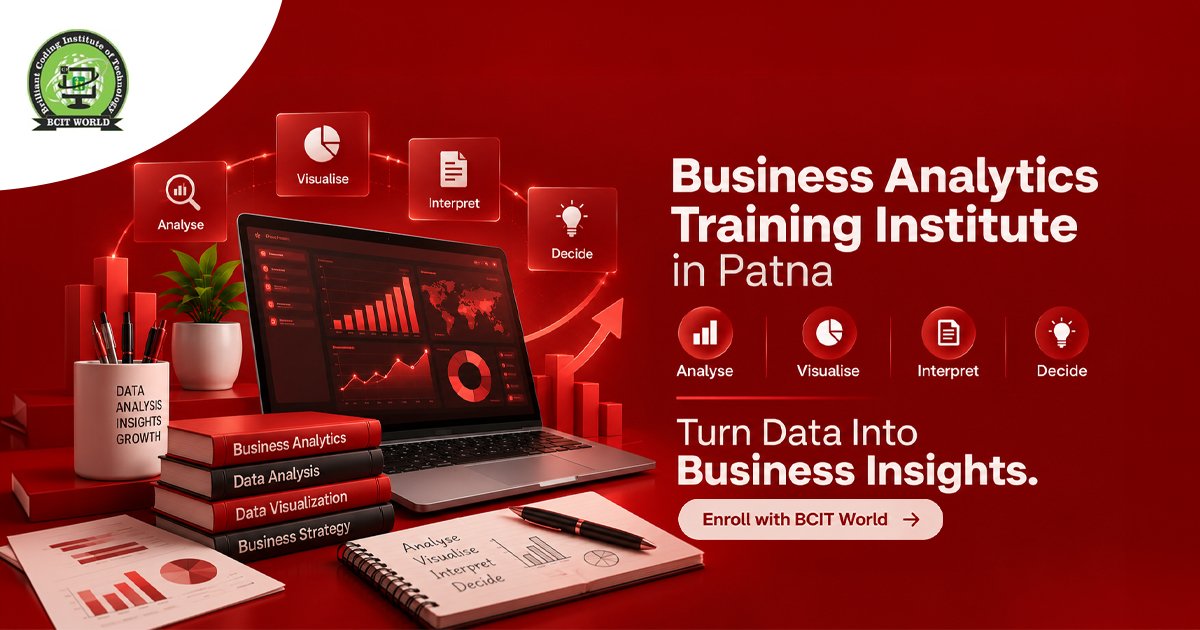
Data can speak volumes about what has happened. Business Analytics helps us to understand the why and what’s next. For instance, a sales report tells us revenue has dropped. But why?
Fewer customers? Fewer sales in a particular territory? Changes in pricing strategy? Underperforming products? Fewer repeat purchases? The solution may be hiding in the numbers, but the challenge is knowing how to find it, understand it, and explain it.
This is where the power of Business Analytics comes into play.
As businesses highly depend on data to execute their planning, marketing, operations, finance, sales, and strategies, analytical thinking becomes more significant. The best Business Analytics Training Institute in Patna can help learners acquire analytical and conceptual competence to work with data and comprehend the business problems it can help resolve.
At BCIT World, the idea is to help learners move from working with numbers to understanding how data can help answer business questions.
In this Article
What Is Business Analytics?
Business Analytics can be described as the use of data, analysis, and digital technologies to examine a company’s performance and gain actionable insights that drive improvements.
In another way, it bridges the gap between data and decisions. It uses the information contained in the data to help organisations make better choices. There is no doubt that businesses are filled with data – they may have thousands of records that include information about:
- Sales
- Customers
- Products
- Expenses
- Marketing
- Website
- Employees
- Inventory
- Operations
The challenge is that raw data rarely speaks for itself. We need business analytics to extract meaning from it.
Some call this the process of Collect → Clean → Analyse → Visualise → Interpret → Decide.
That is why analytics is much more than spreadsheets and charts – it is about asking the right questions to uncover the insights that will benefit the business.
Why Learn Business Analytics?
Organisations generate plenty of information on a daily basis; modern businesses have more data at their disposal than ever before. The real challenge is not in its collection, but in its interpretation.
A business analyst or professionals who understand business analysis are required to observe, analyse, and report on developments, performance, and trends, comparing them to objectives and identifying what actions should be taken.
It is an extensive role that requires a mix of technical and business-oriented expertise. The right Business Analytics Training Institute in Patna can open the door to learning the tools and techniques to think critically about the numbers. At BCIT World, our goal is to help learners gain an understanding of how data can be used in business, and not fall into the trap of just ‘learning Excel’.
Business Analytics Is More Than Numbers
One of the things we like to teach is that there is a big difference between:
• What the data says – the numbers
• What it means – the analysis
• And what you should do about it – the business thinking
For example, you may run an online store and discover that web traffic is up 30%, but sales have remained flat. A report may indicate a rise in site visitors, but an analyst could go deeper and ask:
• Which pages have contributed to the increase in traffic?
• Where are these visitors coming from?
• How many are adding items to their carts?
• Where are they dropping out of the sales funnel?
• Which products are getting the most views?
• Has the conversion rate changed?
This is the type of questioning that a good Business Analytics Training Institute in Patna should encourage – turning raw data into insights that can influence a business decision.
What Will You Learn in Business Analytics?
A proper business analytics qualification should cover tools, techniques, and business knowledge to give a rounded understanding of the field. At BCIT World, learners who want to qualify in business analytics will develop the knowledge and skills relating to:
1. Excel for Business Analytics
Microsoft Excel is a common tool for analysing business data. However, business analytics requires more than simply knowing how to use a few Excel functions. We will give you an understanding of the following key areas:
• Advanced Formulas
• Lookup Functions
• Pivot Tables
• Data cleansing
• Sorting & Filtering
• Conditional Formatting
• Charts & Graphs
• Data Summarising
• Reporting
• Dashboard Creation
Essentially, we will turn you from a spreadsheet jockey into an Excel wizard capable of transforming raw data into meaningful insights.
2. SQL and Database Analysis
Most businesses keep large amounts of information in databases. Structured Query Language (SQL) is used to interrogate and manipulate these databases to extract the information we need.
We will give you an understanding of the fundamentals of SQL, including:
• Queries
• Filtering
• Sorting
• Aggregation
• Joining
• Grouping
• Relationships
Knowledge of databases is an important skill that will allow you to move from ‘I have the data’ to ‘I can access the data’.
3. Power BI and Visualisation
Numbers alone may appear sterile and abstract. To give them meaning requires interpretation and presentation of the information in an understandable manner.
Data visualization tools such as Power BI assist in doing this through the creation of dashboards that enable us to visualize the numbers.
Creation of dashboards is usually part of a course in business analytics as it is an important skill to possess. The reason for this is that the purpose of analysis of the data is to derive useful insights from the same that will assist in decision-making in the business.
A good dashboard provides a story about the business – what is taking place, where it is taking place and, most importantly, why it is taking place.
4. Business Problem-Solving
This brings us to our next point: the ability to formulate the business question or problem that needs to be analysed. A business analyst typically does not receive a question – they receive a scenario, such as: “Our sales are declining.”
This is not an analytical question, so a common pitfall is to leap straight into the analysis without fully understanding the problem.
A good analyst will take the time to break it down into parts:
• Which products are seeing reduced sales?
• Which territories are affected?
• When did the decline begin?
• Which customer segments are buying the product?
• Has the pricing changed?
• Has the marketing budget changed?
• Are competitors impacting our sales?
You see, a good Business Analytics Training Institute in Patna will encourage learners to move from problem description to problem analysis.
5. Data Storytelling
Finally, we come to data storytelling – the art of being able to translate the analytical discovery into a compelling insight that others can understand and act upon.
A good analyst will know how to identify the key takeaway and present it in an easily digestible manner. In short, a good analyst knows how to avoid overwhelming the audience with numbers and charts.
Business Analytics vs Data Analytics
It is not uncommon to come across Business Analytics and Data Analytics as terms that are interchanged; however, there exists a slight difference between the two.
Data Analytics is concerned with analyzing the data and drawing patterns, trends, correlations, and insights from them.
The use of such insights for the purpose of determining the performance of the business is what Business Analytics deals with.
To summarize the distinction clearly:
• Data Analysts raise the question.
• Business Analysts convert the answer into action.
For instance, a data analyst would analyze that customers belonging to a certain segment purchase products more often than others.
A business analyst would take the insights and find out ways to increase sales, such as the creation of a loyalty rewards program.
To conclude, the distinction is indeed useful, but proper training in business analytics will help the learner know all about the two concepts.
Career Paths After Business Analytics Training
In today’s business world, several business analytics jobs are available. The actual job titles and duties will differ from one company to another depending on the company size and nature of industry. Some examples of such positions are:
- Business Analyst
- Data Analyst
- Reporting Analyst
- Business Intelligence Analyst
- Operations Analyst
- MIS Analyst
- Marketing Analyst
- Sales Analyst
- Financial Analyst
- Junior Analytics Professional
The responsibilities differ depending on the role and the industry, but generally involve some combination of reporting, dashboards, data interrogation (e.g., SQL), and business analysis.
As you can probably tell, a career in business analytics is far more than simply generating reports; it is about using technology and analytical thinking to drive improvements.
That is why at BCIT World, we believe that the best way to prepare someone for a career in analytics is to give them hands-on experience with the tools and technologies used in the field.
Why Choose BCIT World for Business Analytics Training?
Choosing the right Business Analytics Training Institute in Patna will depend on what you want to learn. So, before enrolling in a course, you must ask yourself what you want to learn. At BCIT World, the fact that we specialise in providing computer education means our students have a broader knowledge of computers and technology, giving them an edge when it comes to analytics.
In short, the best Business Analytics Training Institute in Patna is not defined by the title of the course but by what the learner will actually do and learn throughout the programme.
Start Your Business Analytics Journey With BCIT World
Data is everywhere, but that does not always mean we know what to do with it. That is where the power of business analytics comes in.
At BCIT World, we help our students to develop a broad range of skills that will allow them to work with spreadsheets, databases, and analytical tools, and interpret the results to make recommendations.
If you are looking for a Business Analytics Training Institute in Patna, make the right choice by considering what you want to learn.
After all, the goal of any analyst is to move beyond simply manipulating the numbers and start asking interesting questions. And that is what sets great analysts apart from the rest of the pack.